Chapter 16 — Capstone: screening and critique
Status: DRAFT 1 (2026-09-21), DESIGN v6 §4, §3 W8. New in v6 on the professor review. Sources: production/phase3/DIRECTOR-REJECTIONS.md:4–14; ledger rows 354, 483; production/phase3/post-submission/audit-claude-2026-09-15/CUT28-rock-face-sheet.png. HALFWAY had no cold screening; the Director's own playback notes stand in.
16.0 Objective
Given the delivered film, you can run a three-viewer cold screening with the form, fill the rubric from their answers, and write a self-critique that names one shot to reshoot and what in the bible or the card would change first.
16.1 What you are deciding
Whether the film you delivered is the film you designed, as measured by people who were not there. Every gate before this one asked whether a thing existed or held. This one asks what a stranger felt at the turn, whether they could tell the two people apart, whether any mouth betrayed a line, and whether the sound was ever noticed. Then you decide what you would do again.
16.2 How we did it
We did not screen cold. What we have is the Director's review after the third assembly (DIRECTOR-REJECTIONS.md), which is the nearest thing: one viewer, watching as a viewer, writing what he saw. Its shape is the shape of the form in Appendix C.18:
- On performance: "Dialogue overall sounds like book reading" (:6).
- On identity: "During the look/sigh sequence, the Director reports Rock appears to be a different person" (:9).
- On continuity: "Scene 5 drop/pickup/fitting appears to occur in three rooms" (:8).
- On posture: 6E "does not read as a person sitting in a car" (:10).
- On sync: 4E "remains misaligned" (:7).
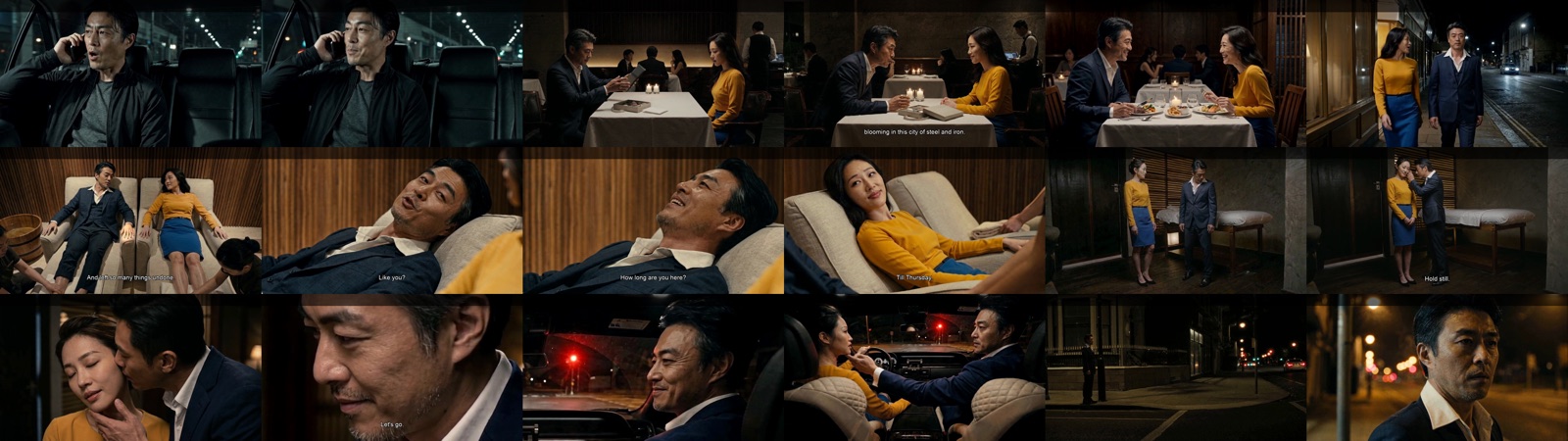
And the sentence that makes it usable as evidence rather than a verdict: "the exact shot attribution is not established by this message; do not silently assign the criticism solely to 7B" (:9). The Director wrote down what he saw and refused to write down what he had not seen. The agent later built a same-size face sheet of every Rock shot before any retake was proposed (below; production/phase3/post-submission/audit-claude-2026-09-15/CUT28-rock-face-sheet.png), and, on a different face claim, retracted its own attribution when a canonical comparison did not support it (row 483: "No established 4D 6A 6E face change").
16.3 Case 16-A — an impression the sheet could not reproduce
- What I saw: the Director's "different person" on playback (row 354). The face sheet: every Rock shot cropped to the same size, side by side. The sheet showed one grooming change (5C, clean-shaven against stubble everywhere else) and no other. The Director's impression had come from the look/sigh sequence, scene 6–7, where the sheet showed nothing.
- Why I think so: a sheet shows frames; the impression was of motion, light and a face held for eight seconds. Both are evidence; they are evidence of different things. The retake that was paid for (5C) was the one the sheet supported. The impression was kept on record and not acted on.
- What I changed: the review discipline in Chapter 0 ("a different angle is not a different person"), and this chapter's form, which asks the viewer what they saw and never asks them which shot.
- Would this happen on your tool? Every screening produces impressions. The rubric turns them into counts; the self-critique is where you decide which impression to spend on.
16.4 Do it with your tools
Three people, a screen with sound, the form on paper, and no you in the room while they watch. The agent tallies the forms into the rubric and builds any comparison sheet a viewer's note asks for (a face sheet, an adjacent-pair strip) so that your self-critique argues from frames as well as feelings.
16.5 Your turn
Time cap: one week to find three viewers; one evening to write. Spend: none.
- ★ Screen to three people who have not read the script, one at a time or together, once, sound on, no pauses, you out of the room. Each fills the form (C.18) before speaking to anyone.
- Tally the forms into the rubric (C.19): story, identity, sync, sound, one to four each.
- Build one sheet for the strongest note (a face sheet, a strip across the cut they named) and look at it with impression first, then frames.
- Self-critique, one page: the one shot you would reshoot, the rung you would use, and what in the bible or the card would change first. The one gate you would not skip next time, and what it cost you to skip it.
- Ledger the screening, the rubric and the critique as decision rows. Commit.
16.6 Gate (W8 — Screened)
Each line needs valid evidence per DESIGN §5; outcomes are pass / fail / unverified, and unverified blocks.
- ★ Three forms exist, filled by three named cold viewers (evidence: the forms, initialled).
- The rubric is filled from the forms, with the counts that set each level (evidence: the rubric).
- One comparison sheet exists for the strongest note (evidence: the image).
- The self-critique names one shot, one rung, one bible or card change, and one gate (evidence: the page).
- Performance task: treat our Director's review (DIRECTOR-REJECTIONS.md:6–10) as one viewer's form: fill Q1–Q6 from it as far as its sentences allow, mark the rest "not asked", and write which rubric levels one form can and cannot set, and why the face sheet does not settle Q5 (evidence: the filled form and the paragraph).
Pass example from HALFWAY: the Director's attribution sentence, an impression recorded without a verdict. Fail example: none available; we never screened cold, which is why this chapter exists.