Chapter 13 — Picture lock and finishing
Status: DRAFT 1 (2026-09-21), DESIGN v6 §4, §3 W6, §11. Sources: PRODUCTION.md:715–756 (D4, D4-b, finishing); production/phase3/ledger.csv rows 554, 568, 573–574, 581; production/phase3/post-submission/audit-claude-2026-09-15/scene5-dim-test-sheet.png.
13.0 Objective
Given all scenes assembled, you can answer D4's three questions in writing, sign lock, polish before colour, unify colour across a scene, let a regenerated shot re-enter selection, and re-sign.
13.1 What you are deciding
Whether the film is finished as a film, and only then how it looks. "The Director watches the assembly as a film, once, straight through, without reference to the shotlist. Three questions, and they are not about conformance: Does it hold for five minutes? Does the turn land? Is it about what the statement says it is about?" (PRODUCTION.md:715–718). "If the answer to any is no, the fix is editorial or structural — reorder, trim, cut a scene, order a new shot — not a better prompt" (:720).
Lock is a signature on a specific cut: "any change after it re-opens the lock and the affected path must be re-walked. Nothing downstream — polish, grade, sound, delivery — starts until a lock stands" (:723–727). Finishing changes shots, so there is a second signature: "the Director watches the finished, graded cut once more and re-signs" (D4-b, :752–756).
13.2 How we did it
The floor. Every cut was measured against the 180 s floor with the credits and packshot inside it. CUT26: "Runtime now 183.8 s incl. 12.1 s credits+packshot: 3.8 s above the 3:00 festival floor" (row 554). CUT29 and CUT30: 4400 frames, 183.33 s, "3.3 s above the 3:00 floor" (rows 568, 573). There was nothing left to trim and nothing to add without a new shot, which is why the director's cut later bought one (Chapter 15).
Lock. CUT30 was handed over as "Candidate for Director playback; then picture lock and score" (row 573). The Director watched and wrote "ok, 锁画面 配乐" (lock picture, score); the ledger row is locked: "CUT30 (cut30-5c-stubble, 183.33 s, SHA256 10f781b81f6f) is picture lock" (row 574). One sentence, one hash.
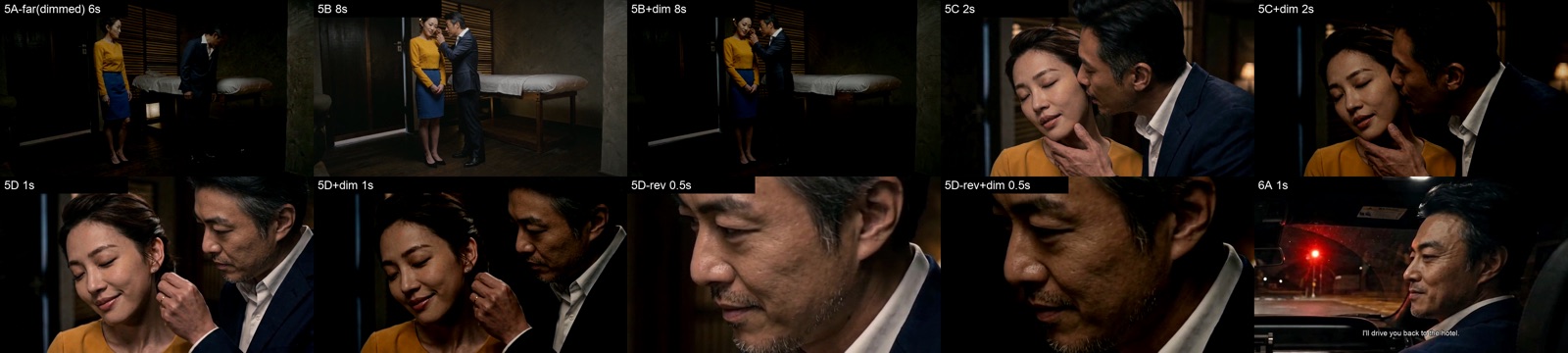
Finishing after lock. Colour: 5A0 and 5A had been dimmed for the Director's note "灯光调暗,隐约的感觉" (dim the light, a suggestion of it), with eq brightness −0.07 gamma 0.82 saturation 0.9. The Director then saw the rest of the earring scene at the old brightness: "戴耳环那个 scene 亮度没有改,要改成一个亮度" (the fitting scene's brightness was not changed; make it one brightness). CUT32 put the whole scene on the one grade and proved it with a test sheet before the render (row 581). Same frame count, same duration, re-signed with the sound.
production/phase3/post-submission/audit-claude-2026-09-15/scene5-dim-test-sheet.png
Regenerated shots re-enter selection. 5C's stubble retake (Chapter 9) replaced 5C in CUT30 only after a 2 fps original-versus-retake strip showed "same blocking and timing" (row 572) and the Director's playback. "A regenerated shot re-enters at D3 for selection" (PRODUCTION.md:738–740); it does not walk straight into the locked cut because it was ordered.
13.3 Case 13-A — the scene that was two brightnesses
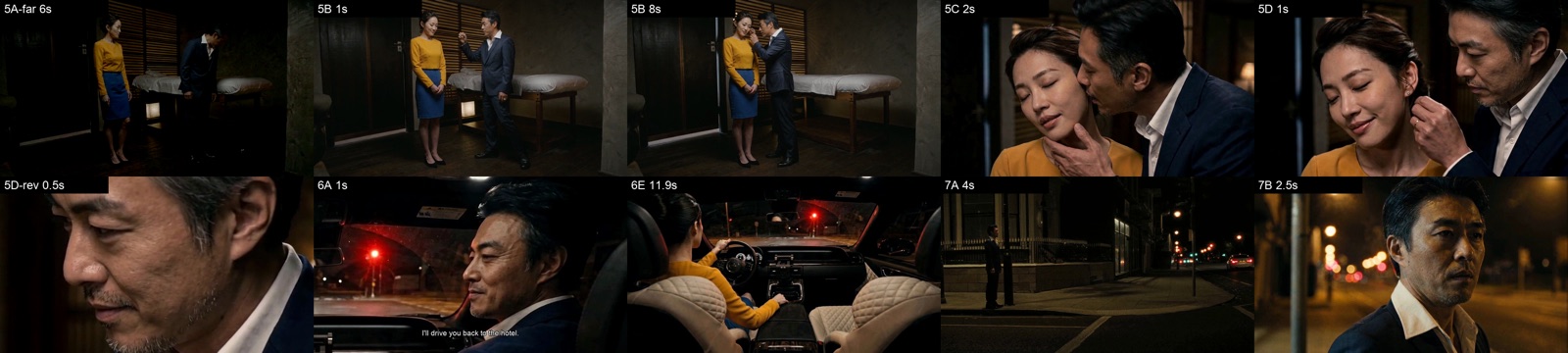
- What I saw: scene 5 in CUT30, locked: the first two shots dimmed, the next four at the original exposure, one room in two lights. The Director's note (above). CUT32 with one grade across all six.
- Why I think so: the dim had been applied where the Director had pointed (5A0, 5A) and nowhere else; the lock was granted on the cut as watched, and the Director's eye had accepted it. Finishing is where a room becomes one light, and the lock was re-signed after it.
- What I changed: the finishing step "colour unification across a scene" with a test sheet before the render, and D4-b. The sheet below is the one the decision was made on: the scene's shots side by side at the candidate grade.
production/phase3/post-submission/audit-claude-2026-09-15/scene56-brightness-sheet.png
- Would this happen on your tool? The grade is ffmpeg, free on any machine. The lesson is the order: lock first, then look at the room as a room.
13.4 Do it with your tools
| Need | We used | Any tool | If yours lacks it |
|---|---|---|---|
| Grade per shot | ffmpeg eq in the build script, per segment |
any editor's colour tool | — |
| Test sheet before render | tiles of one frame per shot at the candidate grade, side by side | any contact sheet | export one frame per shot and look at them together |
| Lock record | a ledger row with the cut folder, duration and file hash | same | a signed line in the ledger with the file name and size |
13.5 Your turn
Time cap: two evenings. Spend: none, unless D4 orders a shot (then the tier budget).
- D4. Watch the assembly once, as a film, sound on, no shotlist. Write the three answers as sentences. If any is no, the fix is editorial; go back to the cut, not the prompt. ★ Then the cold viewer (C.14, whole film).
- Lock. One ledger row: cut folder, frame count, duration, hash, "picture lock", your name.
- Polish: trims and re-orders that D4 asked for, in a new cut folder. Re-walk lock (a new row).
- Colour: one grade per scene, chosen on a test sheet of one frame per shot side by side, then rendered in a new cut folder with the same frame count. Make two sheets of the same frames, one at the cut's current grade and one at the candidate, with no labels, and show both to the second reader with one question: "which of these is one room in one light?"
- D4-b. Watch the finished cut once more. Re-sign with a new row.
13.6 Gate (W6 — Picture lock)
Each line needs valid evidence per DESIGN §5; outcomes are pass / fail / unverified, and unverified blocks.
- All scenes assembled in one cut folder with verification (evidence: the files).
- D4's three answers written as sentences by you, after one straight-through viewing (evidence: the sentences; self-attested viewing).
- ★ A cold viewer who never read the script retold the turn (evidence: the form, initialled).
- The lock row exists with folder, frames, duration, hash (evidence: ledger).
- Every finishing change is a new cut folder; a grade keeps the frame count, a trim or re-order is a re-lock with its own row (evidence: verification files and the lock rows).
- Colour per scene chosen on a test sheet before render (evidence: the sheet).
- The re-sign row exists after finishing (evidence: ledger).
- Performance task: for one scene of your film, the two unlabelled test sheets exist (current grade, candidate grade, the same one frame per shot on each), and the second reader, shown both, picked the candidate as the one light; if they picked the current sheet or could not choose, the candidate grade is not rendered and the scene stays as it was until a new candidate passes the same test (evidence: the two sheets, ★ the reader's pick in their hand, the finishing cut's build script naming the grade that was rendered).
Pass example from HALFWAY: row 574, "ok, 锁画面 配乐", CUT30, 183.33 s, hash. Fail example: the same lock granted on a scene in two lights, found after.