Chapter 5 — Breakdown and shotlist, whole film
Status: DRAFT 1 (2026-09-21), DESIGN v6 §4, §3 W2. Sources: PRODUCTION.md:335–367 (Phase B, G1, D1), :1069–1088 (shot card template); docs/artifacts/HALFWAY-SHOTLIST.md; production/phase3/DIRECTOR-REJECTIONS.md:8.
5.0 Objective
Given the bible and script, you can write a coverage intent per scene, draw the line and eyelines into the spatial map, and produce a whole-film shotlist with one reaction card per beat, the turn shot marked first, and the runtime arithmetic against the floor.
5.1 What you are deciding
Every shot of the film, on paper, before any prompt. "Coverage is designed, not accumulated. Without it you produce technically correct clips that do not assemble into a film — the failure no mechanical gate can catch" (PRODUCTION.md:344–346). Four decisions per scene, then one card per shot:
Coverage intent (PRODUCTION.md:348–353): whose scene is it (the camera favours that person); where is the turn ("the closest size and the longest hold"); what does the audience know and when (ahead, level, behind: pick one); what is the exit (the image the scene ends on and what it hands to the next). "A card that serves no answer above is decoration — cut it before it costs a generation" (:355).
The line (v6): the axis between the two characters, which side the camera stays on, and each single's eyeline in words, so that two singles generated a day apart look at each other.
Cards (template C.12): location asset, characters with state, action, the one line if any, running time, tier (turn / dialogue single / insert) and take budget, shot size described edge to edge, eyeline. One speaker per card. A reaction or listening card for every dialogue beat, because in a generated film that is the cheapest and most reliable shot and the one nobody plans. The turn shot of each scene is marked as the first to generate; a master card only where the intent needs one.
Arithmetic: sum of card running times within ±10 % of the target; no card over the tool's maximum length; generated length = card + 1 s.
5.2 How we did it
The shotlist (HALFWAY-SHOTLIST.md) ended at 38 cards, 285 s, for a 270–330 s band: 6 masters, 20 line cards, 12 silent content cards, longest card 12 s, "one speaker and one line per card, no exceptions" (:64–70). Generation length card + 1 s gave "323 s of generated material for 285 s of cards" (:1767). Each scene has the four blocks: coverage intent, spatial map, shot cards, then the mechanical check (G1, :1732–1745) and the Director's approval (D1).
One intent, scene 6, the turn: "BOTH — she is driving it and he ends it" (:1296). One card, 7M (:1590–1613), shows the shape: MATERIAL (location, characters with the ring's state at that size, action in two sentences, no line, 1 s), DIRECTION (goal, obstacle, task, blocking, acting, a CONTINUITY line), CAMERA (wide, locked, 84°, eye level from the kerb), EDIT (hard cut, one beat, what it hands on).
The mechanical gate passed with no flag. The Director's gate, D1, asks the other question: "not 'are the cards complete' (that is G1) but 'does this coverage tell the story, and does the turn land where the beat sheet says it does?' Cards are cheap to change here and expensive to change after Phase C" (PRODUCTION.md:364–367).
What the shotlist did have in places and did not enforce: some spatial maps state the line (scene 1: "The 180° line runs from the camera to Crystal and is never crossed", :1044); no card states its eyeline, no gate checked a returned pair against the map, there is no reaction card per beat, and no tier. Those are v6 additions, and §5.3 is why.
5.3 Case 5-A — three attractive shots, three rooms
- What I saw: after the third assembly, the Director: "Scene 5 drop/pickup/fitting appears to occur in three rooms. 5A0/5A/5B must share one room, consistent door/wall/table/lamp geometry and actor marks. Individual attractive frames do not pass sequence continuity" (DIRECTOR-REJECTIONS.md:8). Each of the three shots had passed its own read.
- Why I think so: the spatial map said where the door, the table, the screen and the lamp were, from the camera side (HALFWAY-SHOTLIST.md:1040–1067), and it also said "The approved location still was made from the old corner; this axis needs its own view before generation" (:1057–1058). The three cards were generated from one plate seen from one corner, each with its own framing, and nothing checked that the returned rooms joined. The map was right; no gate compared three results against it side by side.
- What I changed: the W5 line "adjacent-shot playback with an eyeline and screen-direction check per cut", and in this chapter: one plate view per camera axis named in the map, and the line drawn so every card says which side it is on. The audit that followed built start-middle-end sheets per scene to look at exactly this:
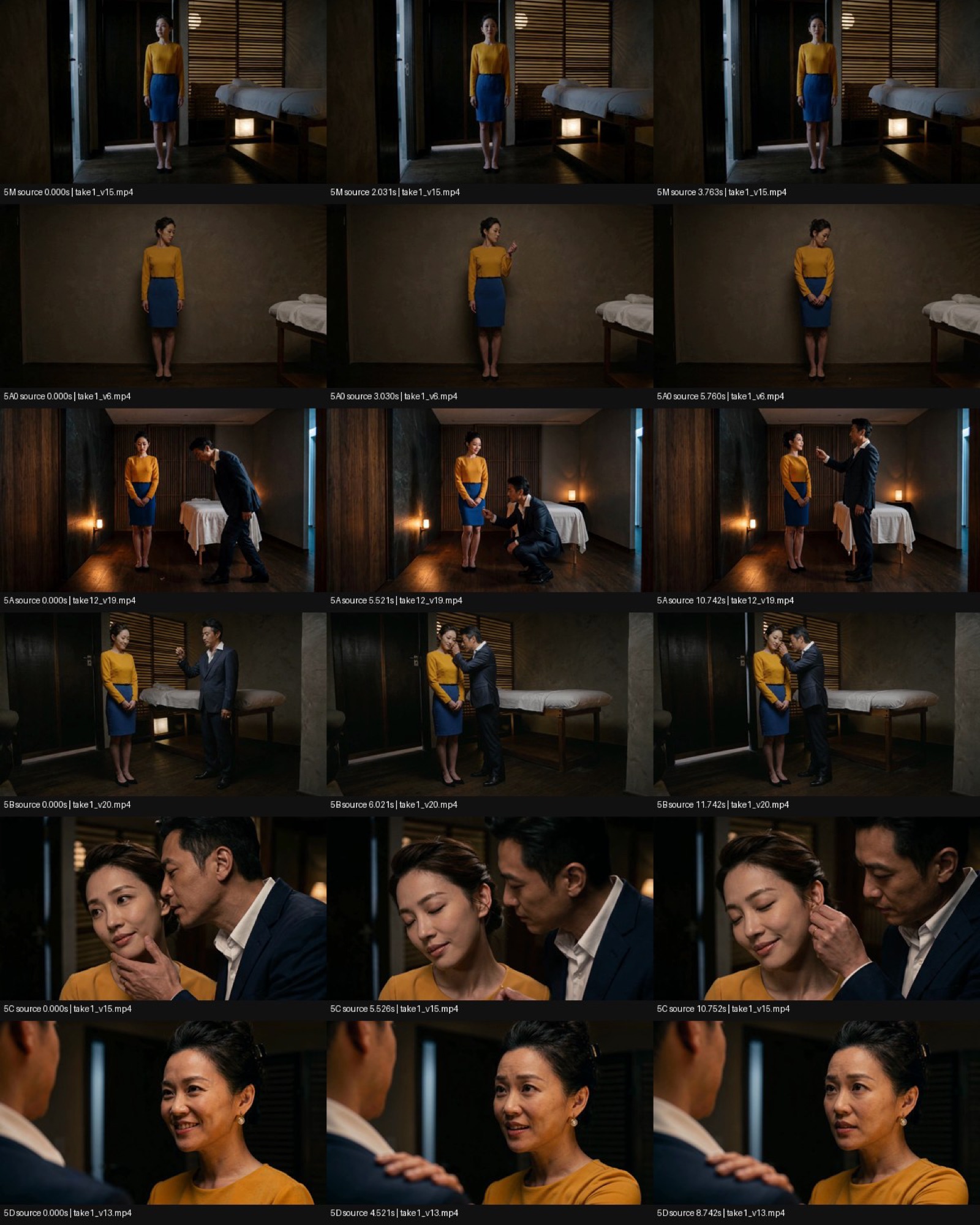
production/phase3/card-audit-2026-09-14/scene5_source_start_middle_end.jpg. Three rooms are visible in the sheet without any note: the wall behind her changes between rows.
- Would this happen on your tool? On every generator that makes one shot at a time. The room does not exist between shots; only your map does.
5.4 Do it with your tools
The shotlist is a text file. The only tool question is whether your generator has a maximum clip length (ours 15 s, so no card over 12 s plus the extra second) and a reference budget per prompt (ours 9 images, 3 videos, 3 audio). Put both numbers at the top of the shotlist and let the arithmetic check them.
5.5 Your turn
Time cap: one week of evenings. Spend: none.
- Coverage intent per scene (C.10): the four answers, plus the line and the list of reaction cards.
- Extend each spatial map (C.11) with the line, each character's side, and the eyeline of every single ("A looks screen-left to B"). Name one plate view per camera axis.
- Cards (C.12), one per shot: tier and take budget from Chapter 6's table (turn 3, dialogue single 2, insert 1), shot size edge to edge, eyeline, one speaker at most, the intention line placeholder (Chapter 8 fills it). Mark the turn shot of each scene "generate first". Add a master only where the intent needs one.
- Arithmetic: sum the running times; check the band; check the longest card against the tool's maximum minus one second; count references per card.
- ★ D1 with the second reader: read them the coverage intents and the card list for one scene. Ask where the turn is. If they point at a different card, the coverage does not tell the story yet.
5.6 Gate (W2 — Breakdown approved)
Each line needs valid evidence per DESIGN §5; outcomes are pass / fail / unverified, and unverified blocks.
- A coverage intent per scene with the four answers (evidence: the file).
- Every spatial map carries the line, sides and eyelines (evidence: the file).
- A shotlist for the whole film; every card names its location asset, characters with state, running time, tier, take budget, size edge to edge, eyeline (evidence: the cards; a script may count the fields).
- One reaction or listening card per dialogue beat (evidence: the list against the script).
- No card with two on-camera speakers; a silent two-shot is allowed (evidence: the count).
- Sum of running times within ±10 % of target; no card over the tool's maximum minus one second (evidence: the arithmetic).
- The turn shot of each scene is marked first to generate; masters only where the intent calls for them (evidence: the marks).
- ★ The second reader pointed at your turn card (evidence: their answer, initialled).
- Performance task: take our scene-5 map (HALFWAY-SHOTLIST.md:1040–1067) and the three cards 5A0, 5A, 5B; write the check you would run on the three returned frame-zero stills, side by side, before any video is bought (which objects you compare, from which map sentence), and the check you would run on the three returned videos' first frames after (evidence: the two checks).
Pass example from HALFWAY: the G1 check, 38 of 38 cards with every field, no flag (HALFWAY-SHOTLIST.md:1732–1747). Fail example: scene 5, three cards that each passed and did not join.